When a wall has to lean, a roof has to slope or a panel has to fold flat, studs cannot do it: a part pressed onto a stud sits flat against the part below. This lesson is about the parts that can, where each one turns, and how to end up at the angle you want.
The situation
A roof has to slope, a wall has to lean, a panel has to fold flat. A part pressed onto a stud always lies flat against the part below.
A clip on a bar is a hinge
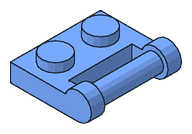
A bar is a rod 3.18 mm thick. It is either a loose part or moulded onto a plate as a handle. A clip is a springy C-shaped grip that snaps onto a bar and can turn around it.
Put the two together and you have a hinge: one part stays where it is and the other folds around the bar.

The rule
Where the pivot is
To know where a folded part will end up you need one fact: where it turns. On a plate with a handle, and on a plate with a sideways clip, the pivot is in the same place: 20 LDU out from the centre of the stud, and 6 LDU above the underside of the plate.
A plate is 8 LDU thick, so its middle is at 4. The pivot is 2 LDU above the middle, and that small lift decides where everything lands.
A clip hinge pivots 2 LDU above the middle of its plate. That small lift is why a right-angle fold lands on the half-plate grid.

Do it
You need a 1 × 2 plate with a handle on its side and a 1 × 2 plate with two clips.
Snap the clips onto the handle and fold the second plate straight up. Hold a plate against its back: it stands half a plate beyond the edge of the first plate, exactly as the drawing says.
In a real set
Modern House, set 31153, 2024.
The loveseat in the wing folds on the parts from this lesson. A 1 × 2 plate with two clips (60470) lies flat under the seat. A 1 × 2 plate with a handle (48336) is snapped into the clips and carries the backrest, a 2 × 4 tile, leaning 15° back from upright.
Checked against the LDraw file of the set, a part-by-part copy of LEGO’s building instructions.

Try it
A 1 × 2 plate with clips is folded straight up on a plate with a handle. Where does its back face end?
Answer
Half a plate beyond the edge of the plate with the handle, because the pivot sits 2 LDU above the middle of the plate.
Watch out
Between the exact angles there are long gaps. A second group fills some of them: triangles whose leaning side misses a whole stud by less than half an LDU, 0.2 mm.
Parts are made about 0.1 mm small on each side so that they slide together, and a clip has a little play on its bar. A miss that small is taken up without visible strain. This site treats half an LDU as the limit; anything larger is left out. Build a close triangle once before you rely on it.

Everything: hinges
- The basic hingeWhere a folded plate ends up
 Building a given angleWhich angles close up, and how to find the nearest one
 Other hingesClick hinges, hinge bricks, turntables and ball joints
 Other clips and barsVertical clips, tile clips and hollow studs
 Kinds of clip15 clips and where each holds its bar
 Kinds of bar and handle15 bars and handles, measured