In lesson 9 an angle closed when a triangle of whole studs did, and the smallest exact triangle in whole studs needs a leaning part five studs long. This lesson gets the same angles, and hundreds more, in two or three studs. The leaning part is held by two hinges side by side, and the parts that hold them sit on a grid five times finer than the stud. Every build in it comes from a catalogue by Jumpei Mitsui (三井淳平さん).
The situation
The 36.9° roof of lesson 9 needs a leaning part five studs long. The model has room for two.
The same angle, a fifth of the size
On the left, the 3, 4, 5 triangle from lesson 9: a floor, a column and a roof five studs long, leaning at 36.9°.
On the right, the same 36.9°, drawn at the same scale. The blue part is held between two hinges 2.2 studs apart, and the whole build is eight parts. Nothing in it is approximate: the angle is exact for the same reason the triangle is.

One hinge turns, two hinges lock
Clip a part onto one bar and it can swing round it. Every other point of the part moves on a circle as it swings, a second clip on it included.
Now give that second clip a bar to hold as well. The part can only stop where the bar sits on the circle, so one position is left and the part is locked.
The roof of lesson 9 is held exactly this way: one hinge at the floor, one on top of the column. There the second bar sits a whole number of studs across and up, and the arrow between the clips runs along the roof. In this lesson both arrows can point anywhere, on a much finer grid.
The rule
Measure the distance between the two bars on the fixed parts. Measure the distance between the two clips on the leaning part, centre to centre.
If the two are equal, the part goes on without bending, at whatever angle makes the clips meet the bars. If they differ it does not go on, or goes on under strain. Lesson 9 allowed half an LDU of difference. Every build in this lesson is exact.
Two hinges lock a part when the distance between them is the same on the fixed parts and on the leaning part. That one condition decides the angle.

A grid five times finer
Turning studs sideways (lesson 4) lets a part start at any plate height, not only at a stud. A stud is 20 LDU, a plate 8 and a brick 24, and all three are multiples of 4.
So in a build made of whole studs, plates and bricks, the distances between hinges are whole numbers of 4 LDU steps: a stud is 5 steps, a plate 2 steps and a brick 6. The steps are the same size across and up, so the grid is square, and distances on it follow Pythagoras exactly.
Lesson 9 counted its triangles in whole studs. Counting in fifths of a stud makes the same triangles five times smaller.
Pick an arrow, double it
Draw an arrow on the grid from the first hinge to the second. In the build above it goes 10 steps across and 2 up.
On the leaning part, the arrow from clip to clip is its mirror image: 10 across and 2 down. A shape and its mirror image are always the same length, so the rule is met without any sums.
To bring one arrow onto the other the part turns by twice the arrow’s slope. The arrow climbs 11.3°, so the part leans 22.6°. That is the 5, 12, 13 angle of lesson 9, which needed a roof 13 studs long. Here it takes five parts, with the hinges two studs apart.
Choose an arrow on the 4 LDU grid and give the leaning part its mirror image. The part locks at twice the arrow’s slope, exactly.
Do it
You need a 1 × 1 plate with clip (61252), a 1 × 2 plate (3023), a 1 × 2 plate with handle on end (60478), a 1 × 2 plate with handle (2540) and a 1 × 2 plate with clip on side (11476, the thick clip). To stand them on: three 1 × 1 bricks. Two 1 × 1 tiles are only for looks.
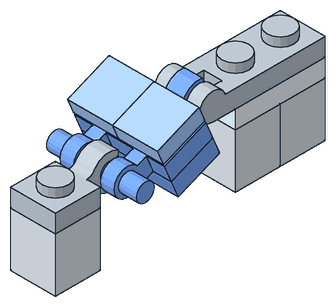
On a base, stand one 1 × 1 brick, leave three studs empty, then stand the other two side by side. Put the clip plate on the single brick with its clip facing the pair. On the pair put the 1 × 2 plate, and on that the plate with the handle on its end, handle facing the clip.
Press the plate with the handle onto the plate with the clip, so that handle and clip stick out on opposite sides. Clip it in between: the handle into the clip on the left, the clip onto the handle on the right. It sits at 22.6° and cannot move.
Now add one more plate under the right-hand side. The distance between the bars grows by 2.3 LDU, almost a millimetre, and the part no longer goes on without bending.
Try it
An arrow goes 10 steps across and 2 up. At what angle does the leaning part lock?
Answer
22.6°: twice the arrow’s slope of 11.3°. The Arrow finder does the same for any arrow.
Watch out
A part locks at twice the slope of its arrow. For 30°, the arrow would have to climb exactly 15°. That is a slope of 0.26795…, and no fraction of whole numbers equals it. The same is true of 45°, 60° and almost every other round angle. So there is always a small miss, and the only question is how small.
A rounder angle needs a longer arrow. Halve the angle you want, take its slope, and find the simplest fraction close to it: that fraction is the arrow.
Where these builds come from
Jumpei Mitsui (三井淳平さん), whose cards started this site, searched by computer for every way to lock a plate between two clip-and-bar hinges with a set of common parts. His catalogue holds 3,449 builds, from 1.2° to 88.8°, all exact. The builds on these pages are from it, with his numbers, redrawn with LDraw parts.
The catalogue is computed. The angles are exact on paper, but the builds have not all been put together yet, and many hang on one stud at each end. Mitsui notes that a locked angle is not a strong one: most of these need reinforcing. Lesson 11 lists what else to check.
Everything: the catalogue
 Mirror, swap and the odd oneThree ways to make the two distances match
 Close to 30°, 45° and 60°How close you can get, and what it costs
 Every five degreesSeventeen small builds from 5° to 85°
 The whole catalogueAll 3,449 builds, to search and download