The rule asks for two arrows of the same length: one between the bars on the fixed parts, one between the clips on the leaning part. Mitsui’s catalogue finds them in three ways, and each way gives a family of builds with its own look.
The mirror
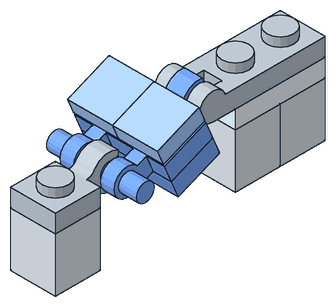
The arrow on the leaning part is the mirror image of the arrow on the fixed parts, reflected in a level line. Mitsui calls this the kite (たこ形).
The part turns by twice the angle between the arrow and the mirror line. Arrow 10, 2 climbs 11.3°, so the part leans 22.6°. Most of the catalogue works this way: 2,235 of its 3,265 builds.



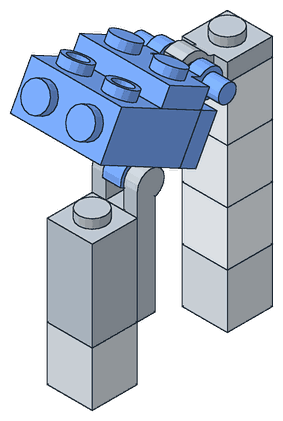
The mirror can stand upright
The mirror line can be upright too. The arrow then runs nearly straight up, and the part turns by twice the angle between the arrow and the upright.
Arrow 1 across and 6 down leans 9.5° from upright, so the part turns 18.9°. The hinges are 1.2 studs apart: this is the smallest build in the catalogue.

The swap
Reflect the arrow in a diagonal line instead, and across and up trade places: 6 across and 5 down becomes 5 across and 6 down. Mitsui calls this the swap (入れ替え形).
The part turns by twice the angle between the arrow and the diagonal: 10.4° here. 907 builds in the catalogue work this way.

Every mirror has a swap twin. The same arrow used as a swap gives 90° minus the mirror’s angle. Arrow 15, 4 gives 29.9° as a mirror (No. 845) and 60.1° as a swap (No. 1721), and in both the hinges are 3.1 studs apart.


The odd one: two arrows on one circle
Some distances can be reached by two genuinely different arrows. 11 across and 2 up, and 10 across and 5 down, are both √125 steps long, because 11² + 2² and 10² + 5² both make 125.
Put one on the fixed parts and the other on the leaning part and they fit. The angle between them is 36.9°, the 3, 4, 5 angle again.
Numbers like 125, 130 and 145 that are a sum of two squares in more than one way give these shortcuts. 123 builds in the catalogue use one.




Lesson 9’s triangles, small
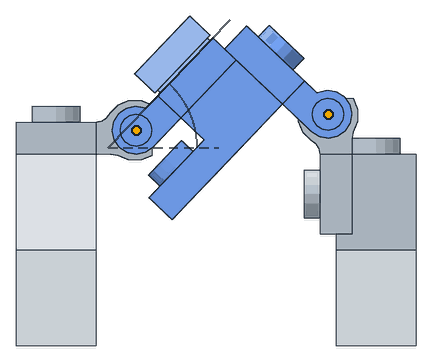
Each exact triangle of lesson 9 gives two angles, and the catalogue has a small build for each. The leaning part of lesson 9 is measured from hinge to hinge, the same as the distance here, so the two columns compare like with like.
| View | Angle | Triangle | Lesson 9 | Here | Parts | Kind | No. |
|---|---|---|---|---|---|---|---|
 | 16.3° | 7, 24, 25 | 25 | 2.2 | 8 | odd one | 454 |
| 22.6° | 5, 12, 13 | 13 | 2.0 | 5 | mirror | 634 |
 | 28.1° | 8, 15, 17 | 17 | 3.0 | 8 | odd one | 793 |
| 36.9° | 3, 4, 5 | 5 | 2.2 | 8 | odd one | 1051 |
| 43.6° | 20, 21, 29 | 29 | 2.2 | 7 | mirror | 1254 |
| 46.4° | 20, 21, 29 | 29 | 2.4 | 7 | odd one | 1337 |
| 53.1° | 3, 4, 5 | 5 | 2.3 | 8 | odd one | 1533 |
| 61.9° | 8, 15, 17 | 17 | 1.8 | 9 | odd one | 1766 |
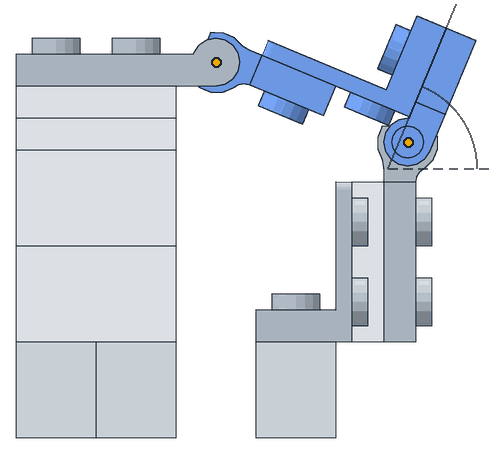 | 67.4° | 5, 12, 13 | 13 | 2.6 | 11 | odd one | 1903 |
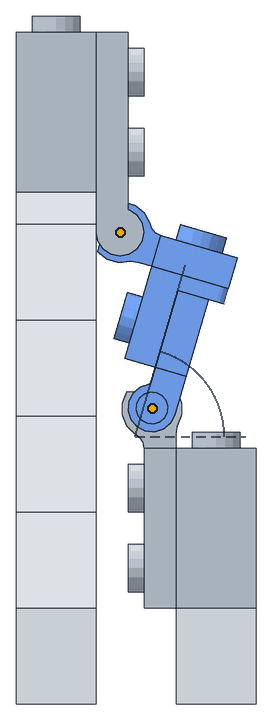 | 73.7° | 7, 24, 25 | 25 | 2.2 | 12 | odd one | 2058 |