To build sideways you first need a stud that points sideways. The parts that have one are called converters on this site, and they are not interchangeable: the one you pick decides where everything attached to it ends up. This lesson shows what decides it, and the three results you can get.
The situation
A wall needs a smooth face: a tile on its side, level with the bricks above and below it. The tile has to hang on a stud that points sideways, and three common parts have one. Press the same tile onto each and it lands in three different places.
What a converter is
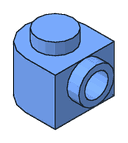
An ordinary brick has studs on top only. A converter also has a stud on a side face, so a part pressed onto that stud is turned a quarter turn.
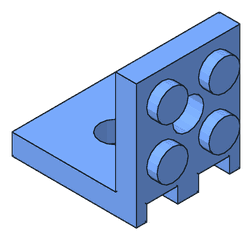
There are three kinds. A brick with a side stud is an ordinary brick with one more stud on its side. A headlight brick has its side stud sunk a little way into the brick. A bracket is a plate with a thin upright wall on one edge, and the studs are on the wall.

What decides where the attached part ends up
Two things, and the first is how far out the face is. The attached part is pressed flat against the face around the side stud, so it starts wherever that face is.
On a brick with a side stud the face is the side of the brick: 10 LDU from the centre, exactly on the edge of the stud column. On a headlight brick it is sunk 4 LDU inside that edge. On a bracket the wall puts it 4 LDU outside.
A tile is 8 LDU thick, a whole plate. So its outer face ends 8 outside the column on the first, 4 outside on the second and 12 outside on the third.
The second thing is how high the side stud is. The attached part is centred on the stud, so a tile one stud wide reaches 10 LDU above the centre of the stud and 10 below it. Where the stud sits between the top and the bottom of the converter decides which edge of the tile comes out level.
The rule
Where a sideways part ends is where the face behind it is, plus its own thickness. On a brick with a side stud the face is on the edge of the stud column, on a headlight brick 4 LDU inside it, on a bracket 4 LDU outside.
Three results
Press a tile one stud wide onto the side stud and one of three things happens. In each drawing the converter is blue and the tile is the dashed outline.


Every converter puts the half plate somewhere: under the attached part, above it, or in its own wall. Choosing a converter is choosing where the half plate goes.
Do it
You need a 1 × 1 brick with a side stud, a 1 × 1 tile and one plain 1 × 1 brick.
Press the tile onto the side stud and stand the plain brick beside the first one. The tile stands a whole plate proud of the plain brick, and stops half a plate above the table. Those are the two numbers this lesson is about: how far out, and how high.

In a real set
Tokyo, set 21051, 2020.
The white block with the printed screens is two tall bricks with two side studs (32952), stacked. A printed 1 × 1 tile sits on the upper stud of the top brick. That stud is 10 LDU below the top of the brick, so the tile ends level with the top, the first of the three results.
Checked against the LDraw file of the set, a part-by-part copy of LEGO’s building instructions.

Try it
A tile on a headlight brick ends 4 LDU outside the stud column. What do you add under it to bring it level with a tile on a bracket, 12 LDU out?
Answer
A plate on its side: 4 + 8 = 12.
Watch out
Four brackets have a different wall, and the sum changes with it. The 2 × 2 bracket with a 2 × 2 wall (3956) has a wall a full plate thick, 8 LDU. The centred bracket (41682) also has a full-plate wall, but in the middle of the plate instead of on its edge, with studs on one face and hollows on the other. The thin neck bracket made for minifigures (42446) has a 3 LDU wall, and the two-stud neck bracket (18986) a 7 LDU one.


More ways
Is a brick with a side stud the only way to turn a stud sideways? No: two or three parts can do it too, and land the stud back on the grid.
Jumpei Mitsui (三井淳平さん) searched by computer for every small build that turns or moves a stud with common parts. These are the smallest of them, with his numbers. Blue parts turn or move the stud; the pale blue plate shows where it ends up.
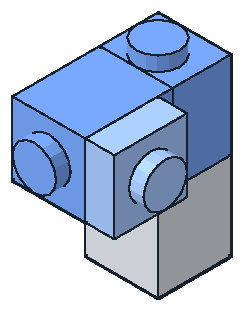

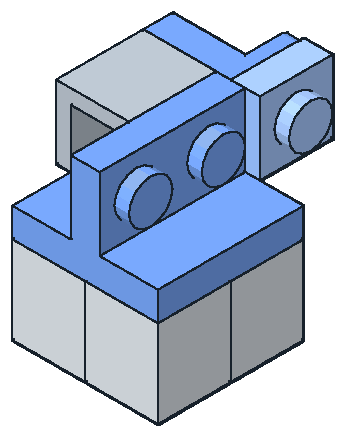
His catalogue is computed, not built: put a build together before you order parts for it.
Everything: converters
- The catalogueTwelve converters and where a tile on each lands
 Bracket wallsNot every wall is half a plate
 Geometry from LDrawLook up a part that is not in the catalogue