Lessons10 · Locked at an angle

Close to 30°, 45° and 60°

Round angles never come out exactly on any grid. They can be approached as closely as you like, and the price is length: each step closer needs the hinges further apart.

Why 30° never closes

A part locks at twice the slope of its arrow. For 30°, the arrow would have to climb exactly 15°. That is a slope of 0.26795…, and no fraction of whole numbers equals it. The same is true of 45°, 60° and almost every other round angle. So there is always a small miss, and the only question is how small.

The arrow is a fraction

Write the arrow as a fraction, up over across. 4/15 is 0.2667 and gives 29.86°. 15/56 is 0.26786 and gives 29.990°. Each closer fraction has bigger numbers, so a longer arrow, so hinges further apart. The swap gives a second route to the same angles, and sometimes a shorter one.

A rounder angle needs a longer arrow. Halve the angle you want, take its slope, and find the simplest fraction close to it: that fraction is the arrow.

Towards 30°
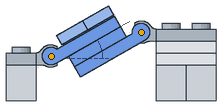
Side view of build No. 845: a blue part between two hinges at 29.9 degrees. Orange dots mark the two hinges, 3.1 studs apart; thin lines on the plate mark its angle against level
29.863°Within ½°. Mirror, arrow 15 across, 4 up. Hinges 3.1 studs apart, 7 parts. No. 845.
Side view of build No. 3208: a blue part between two hinges at 30.0 degrees. Orange dots mark the two hinges, 6.0 studs apart; thin lines on the plate mark its angle against level
30.037°Within 0.1°. Swap, arrow 15 across, 26 up. Hinges 6.0 studs apart, 15 parts. No. 3208.
Side view of build No. 850: a blue part between two hinges at 30.0 degrees. Orange dots mark the two hinges, 11.6 studs apart; thin lines on the plate mark its angle against level
29.990°Within 0.01°. Mirror, arrow 56 across, 15 up. Hinges 11.6 studs apart, 10 parts. No. 850.

All three are drawn at the same scale.

Towards 45°

Side view of build No. 1303: a blue part between two hinges at 45.2 degrees. Orange dots mark the two hinges, 2.6 studs apart; thin lines on the plate mark its angle against level
45.240°Within ½°. Mirror, arrow 12 across, 5 up. Hinges 2.6 studs apart, 8 parts. No. 1303.
Side view of build No. 1294: a blue part between two hinges at 45.0 degrees. Orange dots mark the two hinges, 6.3 studs apart; thin lines on the plate mark its angle against level
44.959°Within 0.1°. Mirror, arrow 29 across, 12 up. Hinges 6.3 studs apart, 7 parts. No. 1294.
Side view of build No. 1296: a blue part between two hinges at 45.0 degrees. Orange dots mark the two hinges, 15.2 studs apart; thin lines on the plate mark its angle against level
45.007°Within 0.01°. Mirror, arrow 70 across, 29 up. Hinges 15.2 studs apart, 11 parts. No. 1296.

All three are drawn at the same scale.

Towards 60°

Side view of build No. 1721: a blue part between two hinges at 60.1 degrees. Orange dots mark the two hinges, 3.1 studs apart; thin lines on the plate mark its angle against level
60.137°Within ½°. Swap, arrow 4 across, 15 up. Hinges 3.1 studs apart, 10 parts. No. 1721.
Side view of build No. 1717: a blue part between two hinges at 60.0 degrees. Orange dots mark the two hinges, 6.0 studs apart; thin lines on the plate mark its angle against level
59.963°Within 0.1°. Mirror, arrow 26 across, 15 up. Hinges 6.0 studs apart, 10 parts. No. 1717.
Side view of build No. 1718: a blue part between two hinges at 60.0 degrees. Orange dots mark the two hinges, 16.4 studs apart; thin lines on the plate mark its angle against level
60.010°Within 0.01°. Mirror, arrow 71 across, 41 up. Hinges 16.4 studs apart, 17 parts. No. 1718.

All three are drawn at the same scale. The shortest arrow within 0.01° would put the hinges 11.6 studs apart, but no build that short is in the catalogue.

How far apart the hinges must be

The shortest exact arrow for each angle and each miss you will accept, worked out from the grid alone. Where Mitsui’s catalogue has no build that short, its shortest is given after the arrow.

Studs between the hinges, for the shortest exact arrow. In brackets: the arrow in 4 LDU steps, across and up.
Angle wantedWithin ½°Within 0.1°Within 0.01°
10°1.6 (6, 5 swap)4.6 (23, 2 mirror)16.1 (80, 7 mirror)
15°3.0 (15, 2 mirror)7.6 (30, 23 swap)7.7 (38, 5 mirror)
20°2.4 (10, 7 swap)2.4 (10, 7 swap)—
30°3.1 (15, 4 mirror)6.0 (26, 15 swap)11.6 (56, 15 mirror)
36°5.9 (28, 9 mirror)7.8 (37, 12 mirror)8.4 (40, 13 mirror)
45°2.6 (12, 5 mirror)6.3 (29, 12 mirror)15.2 (70, 29 mirror)
60°3.1 (15, 4 swap)6.0 (26, 15 mirror)11.6 (56, 15 swap, catalogue 16.4)
72°2.7 (11, 8 mirror)2.7 (11, 8 mirror)20.5 (101, 16 swap, none in the catalogue)

Download CSV

The map of exact angles

Each dot is an angle that closes exactly, placed by how far apart its hinges must be. The low dots are the cheap angles. Round angles sit in the gaps between them.

The shaded band is shorter than any build in the catalogue: an arrow there works on paper, but the parts will not fit in so little space. Double it and the angle stays the same. That is why the 22.6° build uses the arrow 10, 2 rather than 5, 1.

01234560°15°30°45°60°75°90°angle of the leaning partstuds between the hingestoo short for any parts found
Every exact angle with the hinges up to 6 studs apart. The dashed lines mark 30°, 45° and 60°.

Arrow finder

Set the angle you want and how big a miss you accept. The list gives the shortest arrows, mirror or swap, and draws the first. It knows the grid, not the parts: look the angle up in the catalogue for a build that fits.

Angle wanted
30°
Miss up to
AngleKindAcrossUpHinges apart

45° again

In lesson 9, 45° was the awkward angle: the nearest triangle, 12 across and 12 up, misses by 0.6 LDU with a roof 17 studs long. Between two hinges, 45.24° is exact with the hinges 2.6 studs apart, and 45.007° is exact at 15 studs.