Not everything belongs on the grid. Centring a part one stud wide on a part two studs wide, setting a detail back by a hair, making two sideways sections meet: each needs a shift smaller than a stud or a plate. That deliberate shift is called an offset, and this lesson shows which part gives each size.
The situation
A part one stud wide has to sit in the middle of a part two studs wide. On the grid it can only go one stud to the left or right, never in between.
The rule
Three sizes
Three sizes cover almost every case. Half a stud is 10 LDU. Half a plate is 4. A quarter of a plate is 2.
Each comes from a particular part. The half plate is introduced in lesson 3 and put to work in lesson 5, A smooth sideways wall. This lesson covers the other two.
Three sizes, three sources: half a stud from a jumper, half a plate from a bracket wall or a headlight brick, and a quarter plate from a plate stood in a jumper’s half stud.
Do it
You need a 1 × 2 jumper, a 1 × 1 brick and a 2 × 4 plate.
Put the jumper on the plate and the brick on the jumper. The brick stands between two studs of the plate below, with the same space on each side: half a stud.

In a real set
Himeji Castle, set 21060, 2023.
The castle is built almost entirely with studs on top. Its narrow windows and stepped roofs come from bricks set half a stud off the grid, on jumpers and on round plates with an open stud. The slit left between a shifted brick and its neighbour is the window.
Described in New Elementary’s review of the set. The drawing shows the idea with seven parts, not a section of the model.

Try it
A brick stands on a jumper, and the jumper on a plate. How far is the brick from the stud grid of the plate?
Answer
Half a stud, 10 LDU. A second jumper under the brick brings it back onto the grid.
Watch out
The same 2 LDU separates the two versions of the 1 × 1 plate with a ring on its side. They look alike, and only one of them comes out even.


More ways
How do you move a stud by less than a stud and keep it pointing the same way? Each build below moves it by a different amount.
Jumpei Mitsui (三井淳平さん) searched by computer for every small build that turns or moves a stud with common parts. These are the smallest of them, with his numbers. Blue parts turn or move the stud; the pale blue plate shows where it ends up.


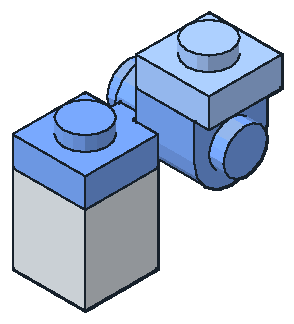

His catalogue is computed, not built: put a build together before you order parts for it.
Everything: offsets
- Half a studCentring odd on even
 A quarter plateThe smallest useful offset
 A slope in stepsLeaning a wall by a hair each course