Some models need studs underneath, or on both faces at once: a ship’s hull, a ceiling, a wing with detail above and below. Stud reversal means making studs point the opposite way from the rest of the model: building part of it upside down, or inverted. No single part does it cleanly, so it is done as a chain: a source with a side stud, sometimes a few spacer plates, then a converter laid on its side, whose own side stud now points down or back up.
The situation
A ship’s hull needs studs on its underside, and a wing needs detail above and below. Every part you have puts its studs on top.
A chain is judged by where its final stud lands. X is how far out from the centre of the source it sits, and Z is how high its base is above the underside of the source. Both are in LDU and both are read off the side view; the third direction, along the wall, does not enter the sums. A chain is useful when both land on the grid, because ordinary parts then connect to it without a gap. This section tests every combination: 448 chains were built, 46 collide with themselves, 317 land between columns, and 85 land on a stud column.
What a chain looks like
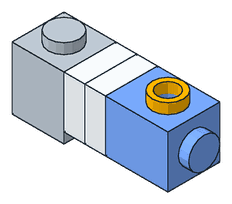
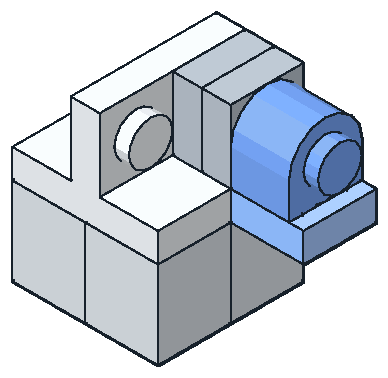
Grey is the source: an upright brick with a stud on its side, part of the model you already have. White are two plates pressed onto that stud, standing on edge. Blue is the converter: one of the side-stud parts of lesson 4, here a second brick with a side stud, pressed on last and so lying on its side.
Lying down, the converter’s own side stud points straight up. That orange stud is what the chain is for. Turn the converter over before pressing it on and the same stud points down.
A chain lands on the grid when its sum is a multiple of 20. A result half a plate off is not a failure: pair it with a second half-plate part and the error cancels.
The rule
Where the last stud of a chain lands is the sum of the parts in it. Add it up in LDU before you build: a chain is worth building when its stud lands on the grid both across and up, because ordinary parts then connect to it without a gap.
Do it
You need two 1 × 1 bricks with a side stud and two 1 × 1 plates.
Press the two plates onto the side stud of the first brick, then press the second brick onto them by its underside, with its own side stud facing up. Stand a third brick beside the chain, two studs along: the new stud is exactly level with the stud on that brick.
In a real set
Modern House, set 31153, 2024.
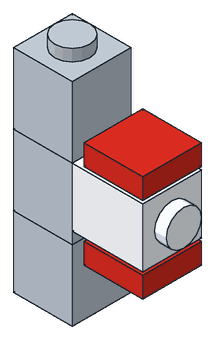
The wing has two wall lights. For each, a grey brick with a side stud (87087) is built into the wall. A black brick with studs on two opposite sides (47905) is pressed onto that stud by its underside, so it lies on its side: one of its studs now points up and the other down. A clear 1 × 1 tile goes on each.
This is a chain with no plates in it. Checked against the LDraw file of the set, a part-by-part copy of LEGO’s building instructions.
Try it
A chain lands 4 LDU short of a stud column. Is it useless?
Answer
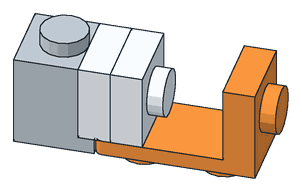
No. Add one part with a half plate in it, such as a bracket wall, and the chain lands on the column.
Watch out
Of the 448 stud-reversal chains, 46 cannot be built because two parts would have to occupy the same space. Two parts cannot be in the same place, however well the sum comes out.
More ways
How else can a stud end up pointing down? Two plates or two headlight bricks back to back flip a stud on top, and three parts turn a side stud down.
Jumpei Mitsui (三井淳平さん) searched by computer for every small build that turns or moves a stud with common parts. These are the smallest of them, with his numbers. Blue parts turn or move the stud; the pale blue plate shows where it ends up.

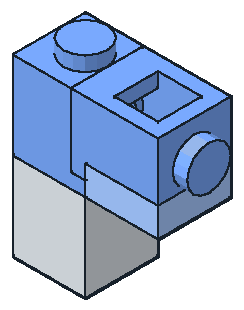

His catalogue is computed, not built: put a build together before you order parts for it.
Everything: chains
- The two sumsPredict where a chain lands
 How many plates betweenThe lookup table for any pair
- Chains that land on the grid85 chains, drawn and filterable
 Studs on two opposite facesOne assembly, studs both ways